
• Home
  • Blog
  • Packaging Production in China

Packaging Production in China: a Factory Visit Case Study on Laminated and Premium Gift Packaging

We show from the inside how a Chinese factory turns cardboard, paper, and flock into brand packaging: the showroom, sample room, and production floor. And we explain what actually affects your price, MOQ, lead times, and defect rate.
Dmitry Belousov
Dmitry Belousov, CEO ECB
Since 2011, he has been turning contract manufacturing in China into a managed system — White Label/OEM/ODM, 3D matrices, QC.
Languages: EN, CN, RU, UA, TR
Publication date: 29.09.2026 | Reading time: 14 min
Packaging production in China is a separate manufacturing project, not a line item reading “packing included” on the product factory’s invoice. Packaging has its own materials, its own die-cutting tools, its own MOQ, its own lead times, and its own defect rate.
We visited a gift and rigid packaging factory in Guangdong, walked through it from the showroom to the assembly line, and filmed what it really looks like without any presentation edits.
In this article, we break down what we saw as working material: what to look for at such a factory, what questions to ask, and which answers should raise a red flag.

In short:
Packaging in China is almost never made by the product factory itself — it is handled by a separate cardboard-and-paper contractor. If you do not control it, you end up with packaging chosen for you by the product supplier, at a price they do not disclose.

A Visit to a Packaging Factory in China: From the Assembly Line to the Finished Batch

Article Contents

  • 1. Terminology: what you need to understand before negotiations.
  • 2. Why packaging is a separate project, not an add-on to the product.
  • 3. Zone 1. Showroom: how to read the factory display.
  • 4. Zone 2. Sample room: where your prototype is born.
  • 5. Zone 3. Production floor: what really shows the level of manufacturing.
  • 6. Types of packaging made in China.
  • 7. Materials and finishing: what creates the “premium” look.
  • 8. What determines packaging price.
  • 9. Project workflow, MOQ, and production lead times.
  • 10. Packaging quality control: what to check.
  • 11. Packaging logistics: flat-pack vs. assembled.
  • 12. 9 importer mistakes when ordering packaging.
  • 13. How to choose a packaging factory: checklist
  • 14. FAQ: 12 common questions

Terminology Guide: What You Need to Understand Before Negotiations

Half of the conflicts with a packaging factory are really disputes over words. The importer says “an Apple-style box,” the factory hears “rigid box,” and the result is different board thickness, different paper, and a twofold price gap. Below is the minimum vocabulary worth keeping in front of you.
What “laminated packaging” means. Lamination is the covering of a rigid cardboard base with printed paper. The term entered printing from the German kaschieren — “to cover, to conceal” (ultimately from the French cacher).
The logic is simple: the box body is assembled from binding board 1.2–3 mm thick — it holds its shape, but looks like ordinary grey board, and you cannot print on it directly because the surface is too porous. That is why the thin paper is printed separately (coated paper 128–157 g/m² or designer paper, with foil, varnish, or lamination), then glued onto the body and wrapped around the edges inward. This process is called lamination, and the result is a laminated box.
In English, this is a rigid box (less often a set-up box), and in Chinese — 精装盒 / 天地盖盒. In practice, this is a shoebox-type box, a perfume case, a smartphone box, or a wine presentation box. Do not confuse it with two adjacent terms: lamination is the application of a protective film to paper, while corrugated lamination is the application of a printed sheet to corrugated board, used for large appliances.
The practical procurement takeaway: lamination is partly manual, so it has its own characteristic defects — bubbles, wrinkles, glue bleed, and an open seam at the corner. These are exactly the issues we list separately in the acceptance checklist.
Lamination / laminating — covering a rigid cardboard base with printed paper and folding the edges inward. It is needed because binding board cannot be printed on directly: the surface is too porous.
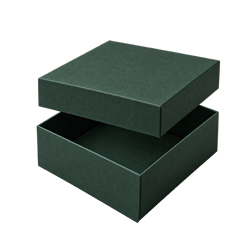
Rigid box / laminated box — a rigid box made of binding board and wrapped (“laminated”) with paper or fabric. It does not fold flat by default, holds its shape, and creates a premium perception. In Chinese — 精装盒 / 天地盖盒. The core product of gift packaging factories.
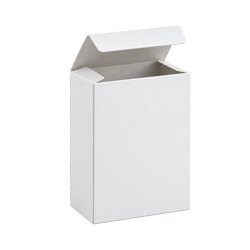
Folding carton / folding box — a box made of heavy coated board (usually 250–400 g/m²) that arrives flat and is assembled manually or by machine. It is many times cheaper than a rigid box and more compact in transit.
Corrugated / corrugated board — transport and e-commerce packaging. It is classified by flute profile: B, E, F, BE. For marketplaces and shipping, E-flute and B-flute are most commonly used.
Greyboard / binding board — the base material for rigid boxes. Density is usually 1000–1600 g/m², thickness 1.2–3.0 mm. The thicker it is, the more “expensive” the box feels — and the higher the material consumption.
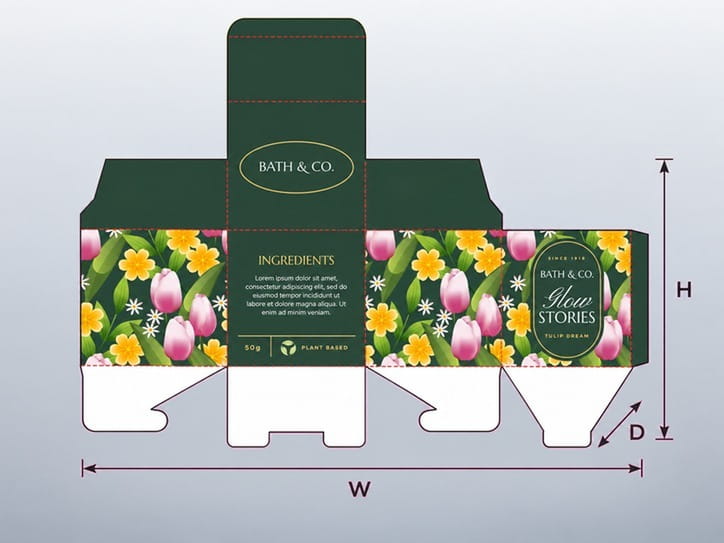
Dieline / layout, cutting die — the packaging cutting drawing with cut, crease, and glue lines. Without an approved dieline, any design is just a picture, not a production file.
Golden sample / reference sample — an approved packaging sample against which the production run is compared: color, board, paper, fittings, geometry, insert. Kept by both the factory and you.
Pantone / CMYK — Pantone is a spot color from a catalog, repeatable from run to run. CMYK is a color built from four inks. A brand’s signature color is almost always fixed in Pantone.
MOQ — minimum order quantity. For packaging, it is determined not so much by the factory’s “greed” as by sheet economics, press make-ready, and die production.
Terms used in China imports

Show all terms (finishing, fittings, tests)

Hot stamping / foil stamping — hot stamping with metallized foil (gold, silver, color, holographic). Requires a separate die — a one-time tooling item in the quote.
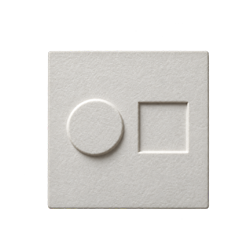
Embossing / debossing — raised or recessed relief. Creates a tactile accent on the logo. Also requires tooling.
Spot UV / selective UV varnish — glossy varnish applied only to part of the image. Works well with matte lamination — the contrast of matte and gloss.
Soft touch lamination — a matte, velvety film. Premium tactile feel, but it marks easily and shows fingerprints — critical for white packaging.
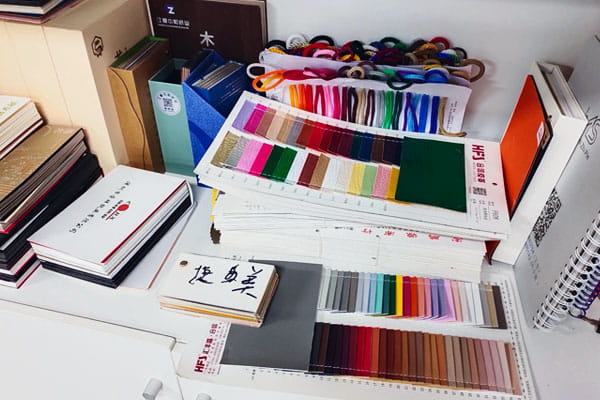
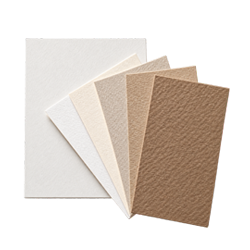
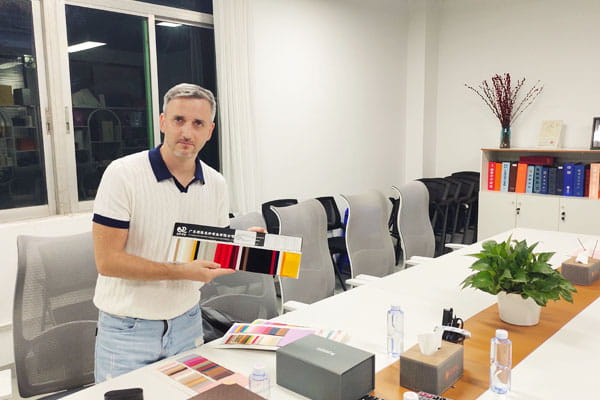
Flocking / velour — a pile coating on the inside of the box or insert. The shade of velvet is selected from such fan swatches — the ones we held in our hands during negotiations.
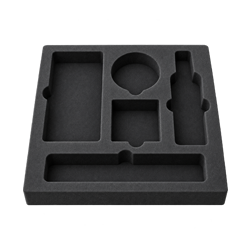
EVA insert / insert tray — a product-shaped insert: EVA foam, cardboard insert, expanded polyethylene, thermoformed PET. Determines both product protection and the unboxing experience.
Magnetic closure — a magnetic catch in the flap. Calculated per unit in the cost and requires manual gluing — a direct impact on price and defect rate.
FSC — certification of pulp origin. For the EU and major retailers, this is often mandatory. Having an FSC logo on the box without a valid factory certificate is a violation.
Food contact — requirements for packaging that comes into contact with the product: EU 1935/2004 and 10/2011, FDA 21 CFR for the US, GB 4806 for China. Inks, varnishes, and glue are checked.
ISTA / drop test — transport packaging tests for impact, vibration, and stacking. Relevant for e-commerce and marketplace shipments.
ΔE (Delta E) — a numerical measure of color deviation from the reference. In practice, packaging is usually agreed at ΔE ≤ 2–3 — otherwise a color dispute becomes a matter of taste.
Flat-pack — packaging delivered disassembled (flat). Saves shipping volume, but shifts assembly to your side.
Why packaging is a separate project, not an add-on to the product

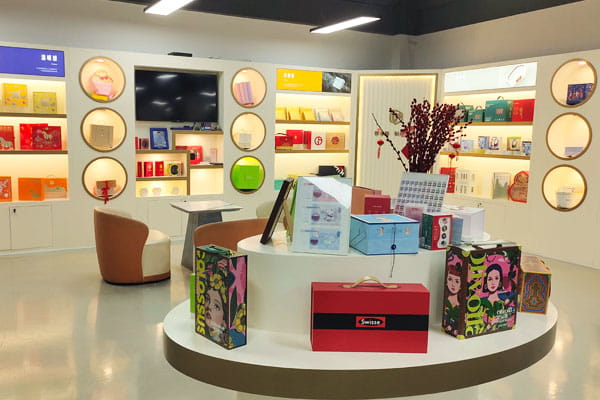
Packaging factory showroom in China with branded box samples
Choosing colors and materials for packaging production in China
Catalog of materials and colors for laminated packaging from China
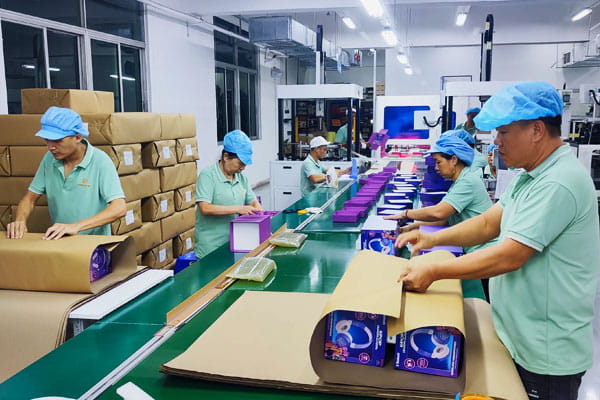
Packing a finished batch of boxes at a factory in China
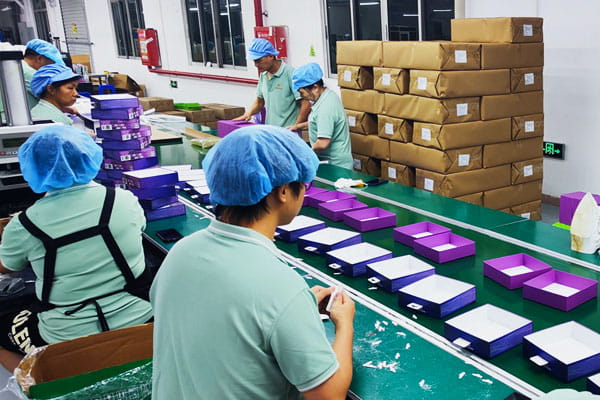
Manual assembly of gift boxes at a packaging factory in China
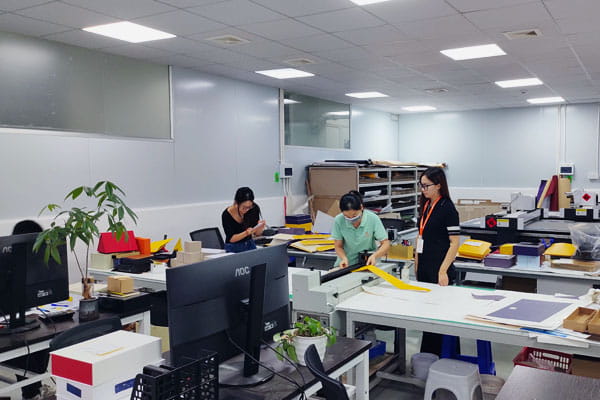
Packaging sample development and quality control department at a factory in China
How premium packaging is made at a factory in China
A typical scenario: an importer finds a product factory, agrees on the price, and only at the end asks, “Will the packaging be yours too?” The factory says, “Yes, we’ll handle it” — and passes the order to a neighboring cardboard contractor, adding its own margin and losing half the requirements along the way.

What you lose in this setup:

Price transparency. Packaging becomes part of the product price, and you cannot see how much the box itself costs versus the intermediary markup.
Quality control. The product factory does not treat packaging defects as its responsibility: “that’s how the boxes were delivered.”
Ownership of tooling. The die, embossing plate, and approved dieline remain with someone else’s contractor. If you change the product supplier, everything starts from scratch.
Speed. Any change goes through the chain “you → product factory → packaging contractor” and back, with meaning lost at every translation step.
That is why we manage packaging as a separate track: separate product and factory sourcing in China for cardboard and paper, a separate specification, a separate sample, and a separate acceptance. Packaging is then integrated with the product at the OEM/ODM contract manufacturing stage, where both the product and its box are fixed in one document set.

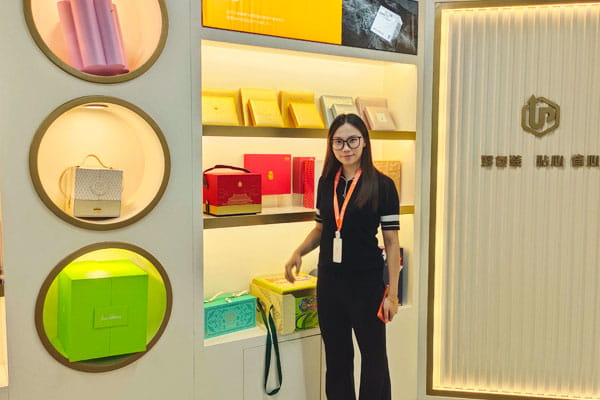
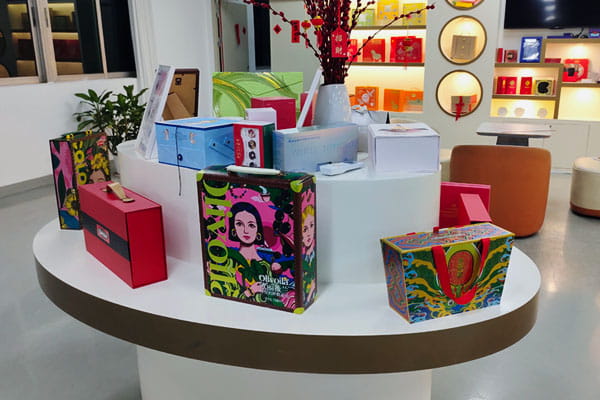
Zone 1. Showroom: how to read the factory display

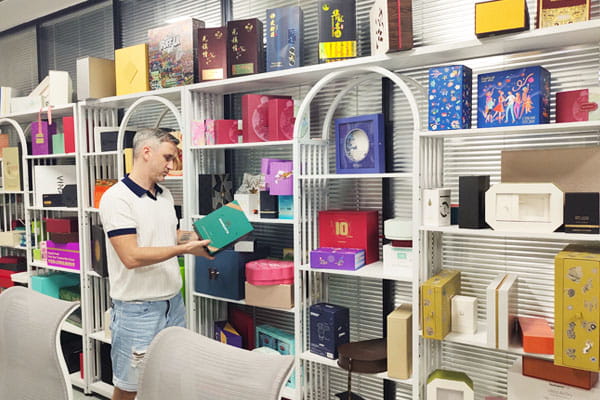
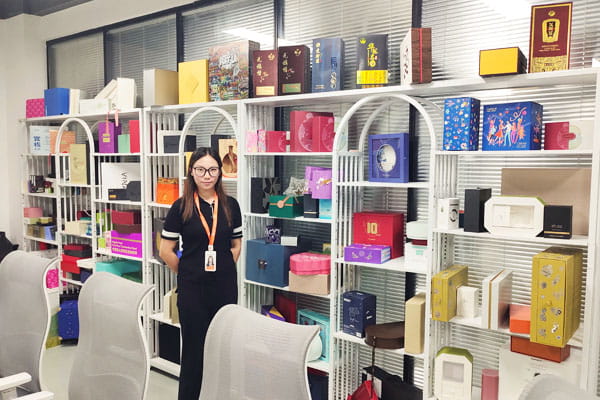
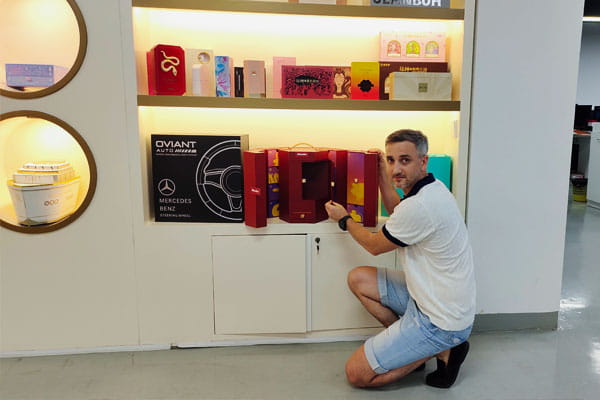
A packaging factory showroom is not decoration — it is the fastest way to understand the factory’s real specialization. We never look at what is merely “nice”; we look at four things.

What we look for in the showroom:

Categories on the shelves. If 80% of the display consists of gift sets, wine, and cosmetics, the factory lives on complex hand-finished boxes. Asking it for a cheap corrugated box for a marketplace order is pointless: the price will be above market.
Brand level. Samples made for international brands are an indirect but useful signal: the factory has at least once passed the audit of a demanding client.
Construction complexity. Book-style boxes, magnetic flaps, pull-out drawers, boxes with handles, windows with PET inserts, multi-layer inserts — these are different manufacturing competencies, not just “boxes.”
Freshness of samples. Dusty, faded boxes on the top shelves mean demand in this category dried up long ago.
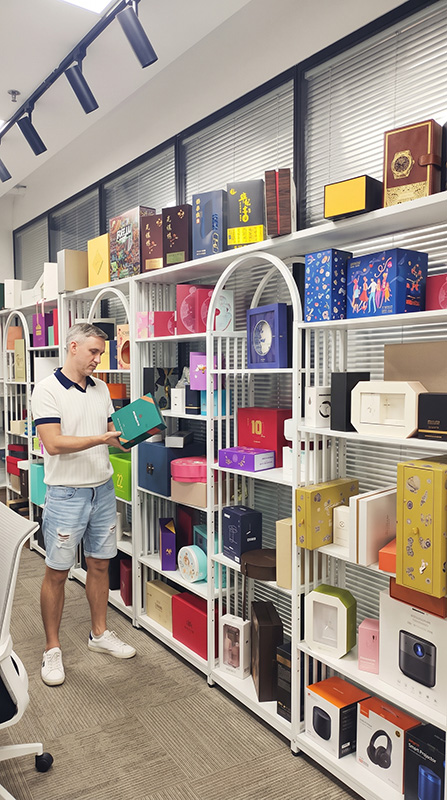
Packaging factory in China - manager in the gift box showroom
Packaging factory showroom in China with branded box samples
Samples of gift packaging from China on factory shelves
Manager at a Chinese packaging factory beside a collection of finished boxes
Audit of premium packaging samples at a factory in China
Premium packaging showroom at a factory in China
Practice: in the showroom, we always ask to take the box apart — peel back a corner of the wrap, inspect the cardboard cut edge, and remove the insert. A factory that refuses to “damage the sample” is usually not ready for a batch audit either.
The factory manager shows the product lines by box type. The key question at this stage is not “how much does it cost?” but “what do you make in-house, and what do you outsource?”

Materials: why velvet is chosen in person

A flock swatch fan from a specialized textile supplier. Shade, pile length, and density are selected physically — fabric color is never approved from photos.
Interior finishing is the part where quiet substitutions happen most often. Velvet, flock, designer paper, and linen textures come in dozens of density grades, and the difference between the sample and the production run is easily lost in correspondence. That is why the material is fixed by three things: the supplier’s article number for the fabric/paper, a physical swatch signed and dated, and a cut-edge photo in the specification.

Zone 2. Sample Room: Where Your Prototype Is Born

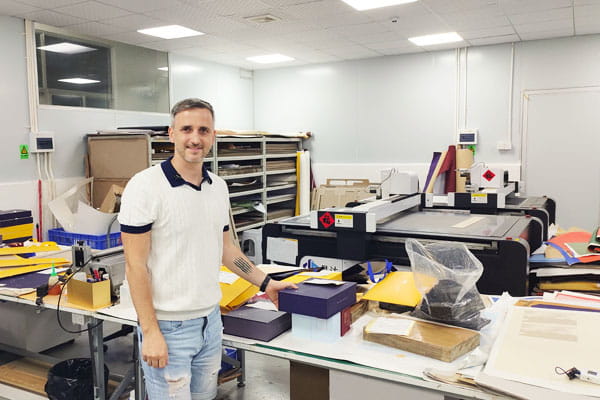
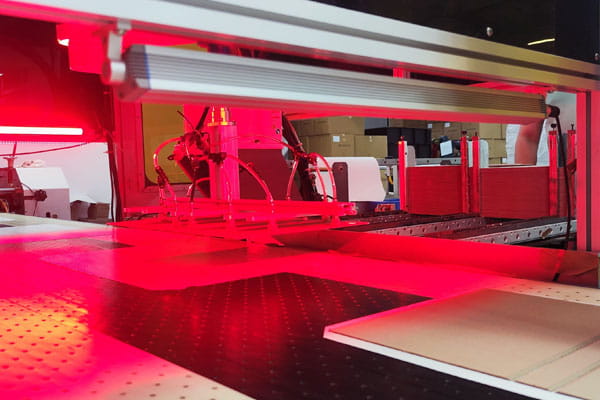
The sample department is the most underestimated area of the factory. This is where it is decided whether your project will be manageable at all. The key piece of equipment is a digital flatbed plotter (sample cutter), which cuts the dieline directly from a file without making a metal cutting die.

What we usually look at in the sample room:

Rapid prototyping equipment. The flatbed plotter should cut cardboard, paper, and insert material directly from the file. This makes it possible to test the structure within 1–3 days before paying for the cutting die and starting mass production.
The packaging designer’s competence. We check whether the specialist can do more than just open a ready-made dieline — whether they can calculate tolerances, crease positions, board thickness, and lid fit for a specific product.
Testing the sample with the actual product. The box and insert are tested with the real item or an exact dimensional and weight mock-up. A check based only on table dimensions will not reveal play, misalignment, or an overly tight fit.
Fixing the materials and sample version. Every prototype must have a version number, date, article numbers for the paper, board, and insert, and the approved pre-production sample must have golden sample status. Otherwise, the factory may quietly change the material between the sample and the production run.
Choosing colors and materials for packaging production in China
Developing a packaging sample at a Chinese factory in the sample room
Packaging sample development and quality control department at a factory in China
Sample room: this is where the first samples are assembled by hand, before the die and printing press are launched

Three Types of Samples You Need to Distinguish

Sample type
What it checks
Typical lead time
What it does NOT show
White sample / 
white mock-up
Structure, dimensions, product fit, lid movement, insert
1–3 days
Color, print, finishing, material feel
Digital / colour proof
digital color proof
Layout, text legibility, overall color
2–4 days
Exact Pantone: digital printing differs from offset
Pre-production sample / 
pre-production sample
Everything at once: material, print, foil, lamination, fittings, assembly
7–15 days
Stability in mass production — only the first batch shows that
Interior finishing is the part where quiet substitutions happen most often. Velvet, flock, designer paper, and linen textures come in dozens of density grades, and the difference between the sample and the production run is easily lost in correspondence. That is why the material is fixed by three things: the supplier’s article number for the fabric/paper, a physical swatch signed and dated, and a cut-edge photo in the specification.

Two documents that hold the project together

Dieline - layout, cutting die for packaging
Dieline (layout, cutting die) — the flat box cutting drawing: cut lines, crease lines, glue areas, and bleed allowances for paper wrap. The cutting die is made from it — a plywood base with steel blades.
Important: the mock-up and the dieline are different things. First, the factory provides a layout for your dimensions, then the designer works on top of it. In the opposite order, the logo ends up on the fold and the text falls under the edge.
Golden sample (reference sample) - physical packaging sample
Golden sample (reference sample) — the physical sample approved by both sides, against which the entire production run is checked. It is made with production materials, in two copies: one stays with the factory on the shop floor, the other is with you. 
Each one has a label with the date, project number, and signatures. Without a reference sample, a quality dispute becomes a matter of opinion; with one, the inspector places a box from the batch next to it and records the deviation.
Practical takeaway: the golden sample should be the pre-production sample made with production materials. A white mock-up only approves the geometry. We fix this step separately in the specification so the factory cannot blur the distinction — this is one of the typical points where the importer loses control of the project.
Separately about the product inside the box: the packaging sample is always checked with the actual product inside, not “by the dimensions in the table.” A ±1–2 mm product tolerance turns into insert binding or rattling during transport. If the product is still in production, we use a dimensional mock-up with exact measurements and weight.

Zone 3. Production Floor: What Really Shows the Level of Manufacturing

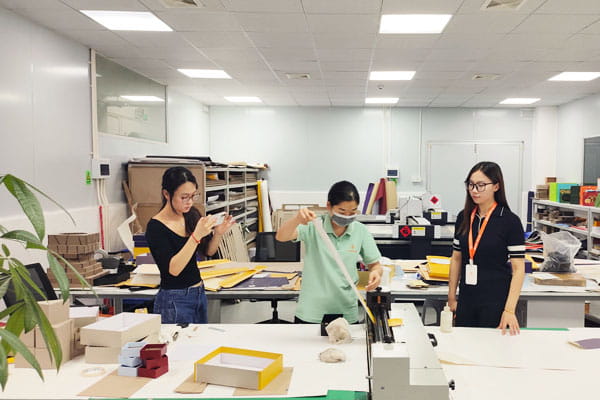
On the shop floor, we look not at “how many machines there are,” but at the chain: equipment → people → order → control. A new machine by itself guarantees nothing.

What we record during a packaging factory audit:

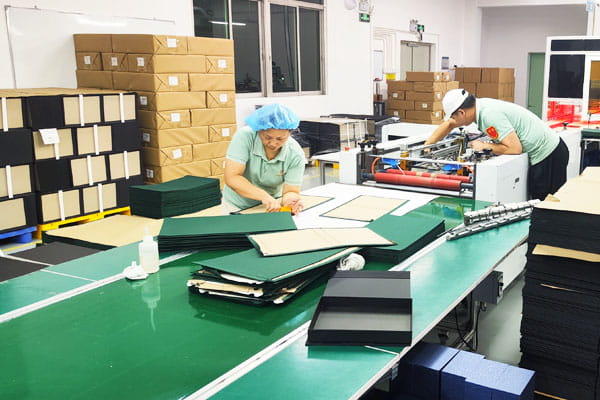
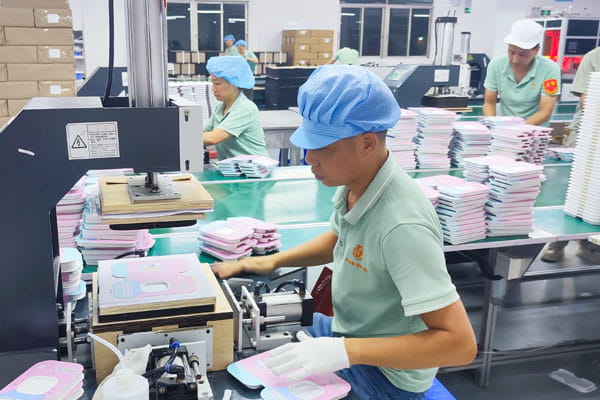
Balance between automation and manual labor. A laminated box is always a partly manual operation. The more manual steps there are, the more quality depends on the shift and the season (after Chinese New Year, there are often new people on the line).
In-line control, not just end-of-line control. A well-run shop floor catches defects at the point of operation instead of sending everything to final sorting.
Conditions for paper and board. Humidity warps board and causes the wrap to shift. Storing paper in an open, unventilated area creates a risk of warping in the production run.
Hygiene, if the packaging is for cosmetics, supplements, or food. Hair covers, gloves, and a separate assembly area are not formalities — they are part of end-brand requirements.
Marking and zoning. Yellow lines, designated areas, and separated work-in-progress are an indirect but reliable sign of process control.
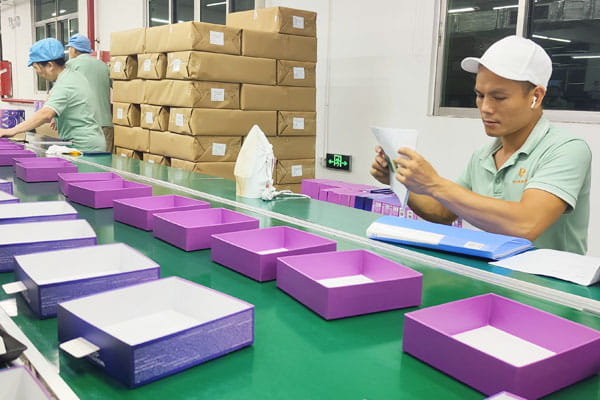
Assembly of gift boxes on the conveyor line at a packaging factory in China
Packaging production in China - workers on the laminated box line
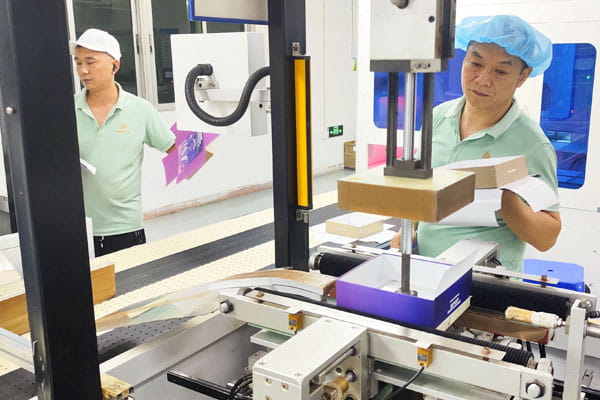
Press for wrapping laminated boxes with paper in China
Laser cutting of board for packaging production in China
Cutting board for laminated boxes at a factory in China
Operator on the laminated box production line in China
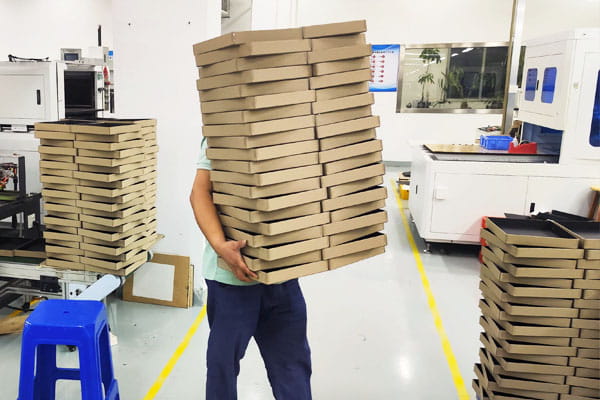
Packing a finished batch of boxes at a factory in China
Manual assembly of gift boxes at a packaging factory in China
Finished batch of cardboard boxes in packaging production in China
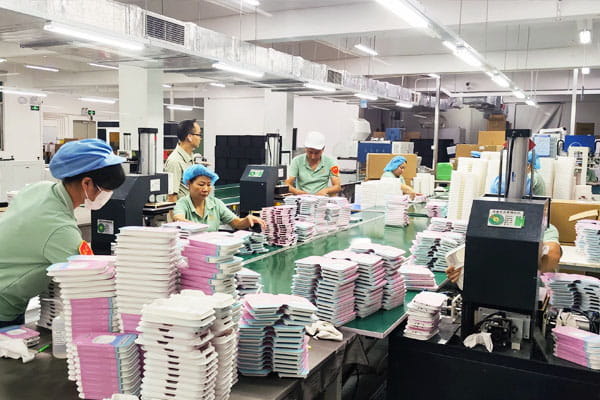
Packaging production shop floor at a factory in China

We will organize factory visits in China, conduct negotiations and agree on terms, and audit the factory with photo and video reporting

Types of Packaging Made in China

The first decision in a packaging project in China is not the color or the logo, but the construction. It determines the price, MOQ, and shipping volume.
Packaging type
Photo
Construction
Where it is used
Approximate MOQ*
What matters to control
Rigid box /
laminated box
Rigid box / кашированная коробка
Greyboard + paper/fabric wrap, lid-and-base, book style, magnetic closure, drawer
Electronics, cosmetics, perfume, gift sets, alcohol
from 500–1,000 pcs
Types of packaging made in China
Folding carton / 
folding box
Folding carton /  складная коробка
Coated board 250–400 g/m², hand-assembled or machine-assembled
Cosmetics, dietary supplements, food, accessories, retail
from 3,000–5,000 pcs
Creasing accuracy, glue seam strength, color stability
Corrugated / 
corrugated box
Corrugated / гофрокороб
Corrugated board B/E/F/BE, self-locking and flap constructions
E-commerce, marketplaces, transport packaging
from 1,000–3,000 pcs
Bursting/compression resistance (BCT), print quality on corrugated board, drop test
Paper tube / 
tube
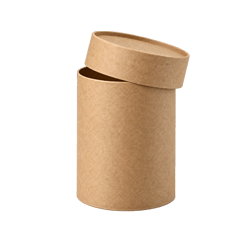
Paper tube / тубус
Spiral-wound board, caps, metal or cardboard bottoms
Tea, coffee, candles, cosmetics, gifts
from 1,000–3,000 pcs
Cap alignment, winding quality, moisture protection
Foldable rigid box / 
foldable laminated box
Foldable rigid box / складная кашированная упаковка
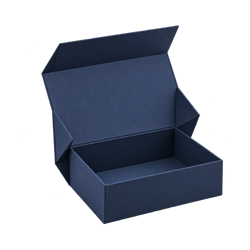
Rigid-box quality, but delivered flat and assembled with magnets
Export gift sets, premium e-commerce
from 1,000 pcs
Hinge and magnet reliability, number of assembly cycles
Bags and textiles
Пакеты и текстиль
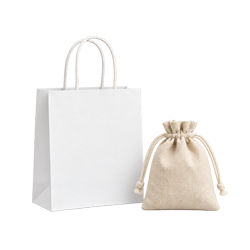
Paper bags with rope handles, pouches, covers
Retail, gift set packaging
from 1,000–3,000 pcs
Handle strength, bottom reinforcement

Materials and Finishing: What Creates a “Premium” Look

Packaging “premium quality” is measured not just by budget size, but by the combination of carefully considered visual and tactile choices. The first impression of a product is formed before it is even unboxed: the weight of the box, the texture of the material, the pleasant relief, and refined accents subconsciously signal high brand status and the quality of the contents to the buyer.
To achieve an expensive look, it is not necessary to maximize board thickness or choose the most expensive materials. Often, one well-chosen finishing element — such as accent embossing or textured designer paper — delivers a far stronger effect than simply making the base more expensive across the board. Below are the key options, their impact on cost, and the potential risks that should be considered during development.
Solution
Photo
What it gives
Impact on cost
Risks
Binding board thickness (1.2 → 2.5 mm)
Толщина переплётного картона (1,2 → 2,5 мм)
Weight, a sense of “solid monolith”
Moderate, increases with area
Higher shipping volume and weight
Designer paper instead of coated paper
Дизайнерская бумага вместо мелованной
Texture, tactility, color depth
Noticeable price increase
Harder to print: some specialty papers do not accept offset printing without primer
Foil stamping
Тиснение фольгой
Logo emphasis, premium code
Tooling + run = additional costs
Foil peeling on folds and textured paper
Embossing / debossing
Конгрев / debossing
Tactile relief without color
Tooling + run = additional costs
Reverse-side indentation on thin board
Soft touch + spot UV
Matte and gloss contrast
Moderate impact on unit cost
Fingerprints and scuffing on dark backgrounds
Flock / velvet interior
Флок / бархат внутри
A “jewelry-grade” packaging perception
Noticeable price increase, plus manual labor
Shade and pile can vary between batches if the article number is not fixed
Custom-shaped EVA insert
EVA-ложемент под форму
Product protection, unboxing experience
Depends on thickness and milling complexity
Odour and residual deformation when packed tightly
Magnetic closure
Магнитная защёлка
The sound and feel of closing
Per-unit cost + manual gluing
Misaligned magnets, weak lid retention
About odour. An underestimated defect in packaging for various product categories (children’s products, cosmetics, kitchenware) is a persistent smell of glue or solvent. It is not visible in photos and will not be included in a checklist unless you explicitly add it.
We include an “odour check” item in acceptance for all projects.

What Determines Packaging Price

The price of a box in China is not a “price per piece” — it is a function of the order quantity. The difference in unit cost between 1,000 and 10,000 pieces is often twofold, and the reason is not a discount, but sheet layout and press make-ready.
Driver
How it affects price
What the importer should do
Order quantity
One-time costs (die, plate, make-ready) are spread across the quantity
Ask for pricing for at least three quantities at once: 1,000 / 3,000 / 10,000
Size and layout
A 5 mm change in dimensions can change how many blanks fit on a sheet
Ask the factory whether there is a “free” size close to yours
Materials
Cardboard, paper, fabric, insert, fittings
Fix article numbers, not descriptions like “thick paper”
Printing
Number of inks, Pantone, full-surface or spot printing
Assess whether Pantone is really needed or whether CMYK is enough
Finishing
Lamination, foil, embossing, UV varnish — each pass is separate
Remove finishes the end customer will never see
Manual labor
Assembly, insert gluing, magnet installation, inserts
Count labor intensity: every manual operation is both cost and risk
Tooling
Cutting die, foil plate, embossing plate
Specify in the contract who owns the tooling after payment and how it will be stored
Export packaging
Corrugated outer box, dividers, palletizing
Include it in the calculation: it is often “forgotten” and appears on the final invoice
Also check what you are being quoted in the invoice and during negotiations: EXW, FOB, or delivered price. Packaging is bulky and light — logistics make up a larger share of the final box cost than for most products.
How to calculate cargo weight, volume, and density — see the link.

Project Workflow, MOQ, and Production Lead Times for Gift Packaging in China

Workflow: from dieline to production run

01.

Brief
Product, dimensions, weight, sales market, quantity
02.

Construction
Box type, dieline, insert, detailed dimensions
03.

Materials
Cardboard, paper, fabric, fittings
04.

Sample
Client’s pre-production sample
05.

Golden sample
Approval and storage of the reference sample
06.

Production run
Printing, finishing, assembly, warehousing
07.

Acceptance and audit
QC inspection, labeling, dispatch, shipment
Practical takeaway: every transition between stages is a point where you can stop without losses. If stop points are not defined, the project moves as one continuous block: you only learn about a problem when 5,000–10,000 boxes have already been printed.

MOQ and Production Lead Times for Packaging in China by Stage

MOQ for packaging is almost always negotiable, but reducing it is never free: the factory will either raise the unit price, suggest simplifying the finishing, or place your order as a “top-up” to someone else’s run on the same paper.
Stage
Typical lead time
What most often causes delays
Quotation and proposal
1–5 days
No dieline, no exact product dimensions, no specified packaging materials
White sample (structure)
1–3 days
Unconfirmed product tolerances
Pre-production sample
7–15 days
Custom specialty paper and fittings, tooling production
Production run
15–30 days
Multiple finishing passes, manual assembly, peak season
Acceptance and inspection
1–2 days
No approved golden sample for comparison
Seasonality. For gift packaging factories, peak windows are the run-up to the Mid-Autumn Festival, Chinese New Year, and the Q4 retail season in the West. During these periods, lead times increase and the factory’s attention to small runs drops. Plan your start with a 3–4 week buffer and take into account China’s production calendar.

Packaging Quality Control in China: What to Check

Packaging quality control is significantly different from inspecting the product itself. There are practically no complex functional or technical tests here; instead, visual perfection, precise geometry, accurate color matching, and clean assembly are what matter most. Even a minor finishing flaw, an extra gap, or a shade shift can ruin the impression of the most expensive and highest-quality product.
To avoid defects upon batch acceptance, inspection must be carried out systematically across all critical areas: from matching the color against the reference (golden sample) and testing finish adhesion to checking hardware and the fit of the product in the insert. Below is a matrix of key control parameters, how to verify them, and typical defects with their severity classification.
What to check
How to check
Typical defect
Defect category
Color
Comparison with the golden sample and Pantone under standard lighting (D65), if needed — ΔE
Shade drift between sheets and batches
Major
Geometry and gaps
Measurement, lid fit, opening action
Body misalignment, lid sticks
Major
Wrapping
Inspection of edges, corners, and seams
Bubbles, wrinkles, visible glue, open seam
Major / Minor
Printing and finishing
Inspection at an angle, tape test for foil/lamination adhesion 15–30 days
Foil peeling, scratches, specks, missing print
Major
Hardware
Checking magnets, ribbons, handles, hinges 1–2 days
Misaligned magnets, weak hold, detached handle
Critical / Major
Insert
Inserting the actual product
Loose fit or overly tight fit
Major
Odor
Closed box, opened after 24 hours
Persistent smell of glue or solvent
Major
Labeling
Barcode scanning, verification of SKU, country of origin, symbols
Unreadable code, incorrect SKU, missing marking
Critical
Transport packaging
Checking the corrugated outer box, dividers, quantity per carton
Crushed corners, shortage, lack of protection
Major
Sampling is formed by AQL just like for the product — according to ISO 2859-1 or ANSI/ASQ Z1.4.
Practical note: for packaging, the tolerance for Minor defects is usually more lenient, while for labeling it is zero, because a barcode error blocks sales entirely. The detailed logic of inspections, defect categories, and PASS / FAIL / HOLD decisions is covered in a separate article — how to inspect products and factories in China before payment.

We’ll inspect the packaging before it leaves for the port
Packaging and labeling inspection, comparison against the golden sample, photo and video report, and a batch decision before the balance payment.

Packaging Logistics from China: Flat-Pack vs. Assembled Packaging

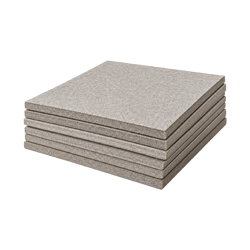
Packaging is low-density cargo. An assembled laminated box carries air inside it, and you pay for that air by volume.
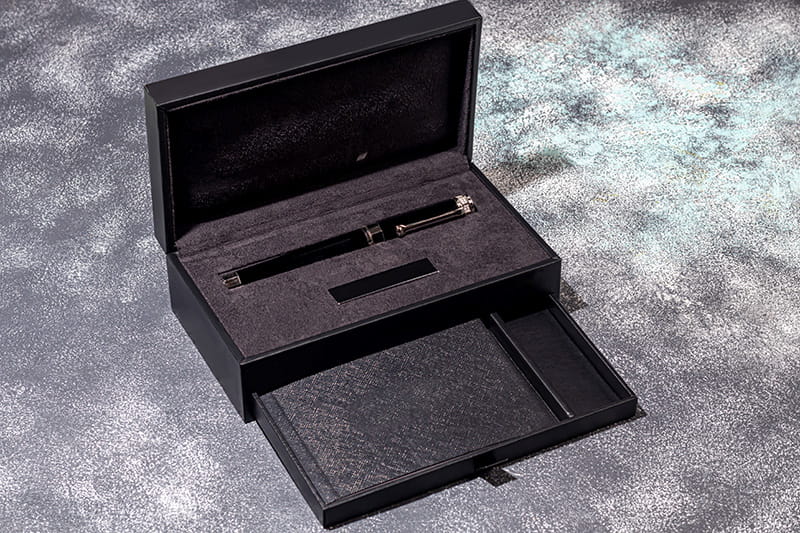
Assembled Rigid Box Packaging
Maximum volume, but zero labor on your side. Justified for small runs and high-value goods.
Foldable Rigid Box Packaging
Arrives flat and is assembled with magnets and hinges. The volume savings are significant, but the construction is more expensive and must be tested for the number of assembly cycles.
Folding Carton
Always flat; assembled at the product filling and packing site.
Nested Supply
The boxes travel together with the goods to the product factory and are packed there. This saves both volume and one logistics stage, but requires synchronization between two production sites.
Packaging logistics from China: flat-pack vs. assembled packaging
How to choose a tax status when registering a company in China
For volume and weight calculations, it is convenient to use our volume and density calculator and container loading calculator — compare the two construction options before approving the sample.

TOP 9 mistakes importers make when ordering packaging in China

Leaving packaging entirely to the product factory.

You can’t see the price, the contractor, or the tooling.

Approving color from photos in a messenger app.

A screen is not a reference. Color must be fixed with Pantone and a physical sample.

Approving a white mock-up as the golden sample.

The geometry is approved, but the materials and print are not.

Not checking the fit with the actual product.

The insert is made “to drawing,” while the product arrives with tolerance.

Forgetting the export corrugated outer box.

A beautiful box arrives with crushed corners because transport packaging was never discussed.

Using the FSC logo without certification.

Using the mark without a valid supply chain is a direct violation and a risk to the retail contract.

Ordering a run for an unapproved product.

If the product changes by 3 mm, the packaging becomes a total reject.

Not defining ownership of tooling.

When you switch factories, the die and plates stay with the old contractor.

Saving on packaging acceptance.

The product is checked, the box is not. Yet it is usually the box and labeling that block sales.
Example of a project we delivered - a corporate gift with a secret
An example of a project we delivered — a corporate gift in premium packaging with a “secret” compartment for a major IT company.

How to Choose a Packaging Factory in China: Question Checklist

Which processes do you handle in-house, and which do you outsource to subcontractors?

Show three finished samples similar to our project, with their production runs.

What is your minimum MOQ for our construction, and how will the unit price change?

What tooling is required for the project, how much does it cost, and who owns it after payment?

What tests do you perform: lamination adhesion, foil durability, strength?

What are the storage terms and shelf life for our golden sample?

Do you have FSC certification, and which materials exactly does it cover?

Who legally issues the invoice, and is the legal entity the same as the factory?

What are the real production lead times during peak season and before holidays?

What defect rate is acceptable in the batch, and what is the procedure for compensation and rework?

How do you protect our design and trade secrets (NDA signing)?

What are the standards, materials, and composition of your protective transport packaging?


Dmitry Belousov’s advice on packaging inspections for products in China

Easy China Business Expert Commentary

Over 15 years of working in China, we have repeatedly seen a critical risk: an otherwise perfect product gets blocked at the logistics stage or on a marketplace because of packaging defects — a Pantone color mismatch, an unreadable barcode, foil delamination, or looseness in the insert. As the final stage of production and the first point of contact with the customer, packaging defects cost a business far more than the original budget estimate.
We treat packaging as a separate production track with a strict process:
  • we replace subjective judgments with exact material article numbers;
  • we approve a pre-production sample with finishing, not a “white” mock-up;
  • we define a stop point before the main run starts;
  •  we carry out a full packaging inspection, not a formal “while we’re at it” check.

Packaging quality control tools:

Bilingual specification (CN + RU/EN) with Pantone references and material article numbers
Approval of the pre-production Golden Sample with photo documentation and a parameter register
Legal confirmation of tooling ownership rights (dies and plates)
An independent packaging inspection checklist, separate from product acceptance
Comparative calculation of volumetric weight (CBM) for two constructions before approval
Financial stop point: payment held until the final sample is validated

We arrange product and factory inspections in China for your project

Need packaging for your brand from China?

We will shortlist the right factories with a strong reputation, adapt your brief into Chinese, collect quotes for your construction, organize samples, control the production run, and deliver the batch.

FAQ: 12 Common Questions About Packaging Production in China

What is laminated packaging?

Laminated packaging is a rigid box whose body is made from 1.2–3 mm binding board and covered on top with printed paper. The covering process itself is called lamination, from the German kaschieren — “to cover.” You cannot print directly on binding board, so the image is printed on thin paper and then glued to the base. In English, such a box is called a rigid box.

Is it profitable to order packaging in China separately from the product?

Yes, if the run is several thousand units or the construction is complex. A separate order gives you transparent pricing, material control, and ownership of the tooling. For small batches and a simple box, it is usually more practical to keep packaging with the product factory — logistics savings will offset the markup.

What is the minimum packaging run in China?

For laminated boxes, typically 500–1,000 pieces; for folding cartons, 3,000–5,000; for corrugated boxes, 1,000–3,000. MOQ is negotiable, but a lower quantity is usually compensated by a higher unit price or simpler finishing.

How can packaging cost be reduced without losing quality?

Optimize the dimensions for sheet layout, remove finishes the customer will never see, replace designer paper with coated paper plus textured varnish, increase the run size, and consider a foldable construction to save on logistics.

How long does packaging production take?

A structural sample takes 1–3 days, a pre-production sample 7–15 days, and the production run 15–30 days. Lead times increase during peak season before Chinese New Year and autumn holidays.

How do you lock in packaging color so the run matches the sample?

Specify Pantone in the specification, approve a physical sample and keep it as the reference standard, agree on the tolerance (usually ΔE ≤ 2–3), and compare the batch under standard lighting, not under factory lamps.

How is a rigid box different from a folding carton?

A rigid box is made from binding board and wrapped with paper or fabric — it holds its shape and feels premium, but it is more expensive and bulkier. A folding carton is a foldable box made from coated board, cheaper and more compact in transit.

Who owns the dies and plates after payment?

By default in China, the tooling remains with the factory even if you have paid for it. Ownership and the right to take the die must be written into the contract as a separate clause.

Is FSC certification required for packaging?

It is not legally mandatory everywhere, but major retailers and some EU markets require it in the contract. You may place the FSC logo on the box only if the factory has a valid supply chain certification.

What should be checked in packaging for marketplaces?

Barcode scanability, correct SKU, strength of the transport carton, marketplace labeling and size requirements, and product protection during repeated handling and transfers.

Can packaging be made for food products and cosmetics?

Yes, but the materials, inks, varnishes, and glue must comply with the requirements of the target market: EU 1935/2004 and 10/2011 for the EU, FDA 21 CFR for the US, and GB 4806 for China. This must be confirmed by factory documents, not verbal assurances.

Can a packaging factory be checked remotely?

Partially: the business license, registration, history, samples, and correspondence. But the real level of the workshop, paper storage conditions, share of manual labor, and order on the line can only be assessed on site.

READ MORE
useful materials
How to inspect products and factories in China before payment and shipment
FACTORY AUDIT
How to inspect products and factories in China before payment and shipment
TOP 10 Chinese websites for wholesale purchases
PLATFORM COMPARISON
Top 10 Chinese websites for wholesale purchases: comparison table
Business support in China
ON-SITE SUPPORT
Business support in China: factory visits and negotiations


Request for a Factory Visit and Audit in China
Provide the supplier’s contact details or a link to the factory. We will assess the location, align the visit agenda and negotiation format, and prepare an inspection cost estimate.
Select the one registered to your number
Specify the project budget range
Please specify the country of delivery
Send us the factory link (1688 / Alibaba / website), specify the location (city/province), and the purpose of the trip: production audit, price/OEM negotiations, prepayment verification, or final inspection.
Натискаючи на кнопку, Ви даєте згоду на обробку персональних даних